How many parties do we need to decide after one proposal and one round of voting, when some faults are Byzantine and others are crashes? The answer depends on both the faults we must tolerate for eventual progress and the faults we want to tolerate on the fast path.
This post is based on the elegant lower bound in the unpublished technical report of Dutta, Guerraoui, and Vukolić, 2005. A similar bound was proven 20 years later in Hydrangea. This bound extends Why BFT Needs Three Rounds in two ways:
- It requires the protocol to be safe and live against $f$ Byzantine faults and $c$ crash faults. For $c=0$ and $p=f$, the $n=5f-2$ lower bound already appears in Abraham et al. and Kuznetsov, Tonkikh, and Zhang.
- It requires the protocol to have a two round good case when there are at most $p$ faulty parties. For $c=0$, the $n=3f+2p-2$ lower bound already appears in Kuznetsov, Tonkikh, and Zhang.
The generalized result
There are $n$ parties, including the leader. The adversary may control at most $f$ Byzantine parties and at most $c$ additional crash faulty parties. The two fault sets are disjoint. A Byzantine party may behave arbitrarily. A crash faulty party follows the protocol until it crashes and then sends no more messages.
We place no computational bound on the adversary.
The protocol must always satisfy agreement, must satisfy validity when the leader is honest and GST is $0$, and must terminate after GST against the full bounds of $f$ Byzantine faults and $c$ crash faults. We say that its two round good case tolerates $p$ faulty parties if all correct parties decide within two message delays ($2\delta$) whenever GST is $0$, the leader is honest, and at most $p$ parties are faulty, with the Byzantine and crash faults respecting their respective bounds.
Here GST is the global stabilization time. Before GST, message delay is unbounded. After GST, every message from one correct party to another is delivered within $\delta\leq\Delta$ of the later of GST and its send time. The good case latency is the time from the leader’s initial proposal until every correct party decides. Thus, two rounds means one proposal followed by one round of voting, rather than two voting rounds.
The main result is:
Theorem. Let $f\geq1$, $c\geq0$, and $p$ be integers satisfying
\[1\leq p\leq f+c.\]There is no protocol with $n=3f+c+2p-2$ parties that solves Byzantine Broadcast in partial synchrony against at most $f$ Byzantine faults and $c$ additional crash faults and has a two round good case tolerating $p$ faulty parties.
When $(c+2)/2\leq p\leq f+c$, this is tight: with $n=3f+c+2p-1$, a two round good case tolerating the same $p$ faulty parties is possible, as we will show in a future post.
The good news is that proving this generalized result requires only minor changes to the parameters in the base proof.
Proof
As in the base proof, we present the argument with the leader proposing first and other parties then voting. Input-independent messages sent before the proposal can be handled by the standard extension in Abraham et al..
The proof is by contradiction. Assume that a protocol with $n=3f+c+2p-2$ has a two round good case tolerating $p$ faulty parties and show that it must violate agreement.
The case $f=1,c=0$ forces $p=1$ and $n=3$, where Byzantine Broadcast is already impossible against one Byzantine fault. Hence, assume $f+c\geq2$, so the set $C$ defined below is nonempty.
Partition the parties into the leader and five sets $A,B,C,D,E$ with sizes
\[|A|=|E|=p, \qquad |B|=|D|=f-1, \qquad |C|=f+c-1.\]The sets $B$ and $D$ may be empty. In particular, when $f=1$, $B=D=\varnothing$. The prescribed Byzantine behavior of $B$ and $D$ is then vacuous.
Indeed,
\[1+|A|+|B|+|C|+|D|+|E| =1+2p+2(f-1)+(f+c-1) =3f+c+2p-2.\]The condition $p\leq f+c$ implies that either $A$ or $E$ can be made entirely faulty using at most $f$ Byzantine faults and $c$ crash faults.
We consider three executions: a mixed world $M$, a corrupt world $\hat D$, and a validity world $V$.
World $M$ (mixed)
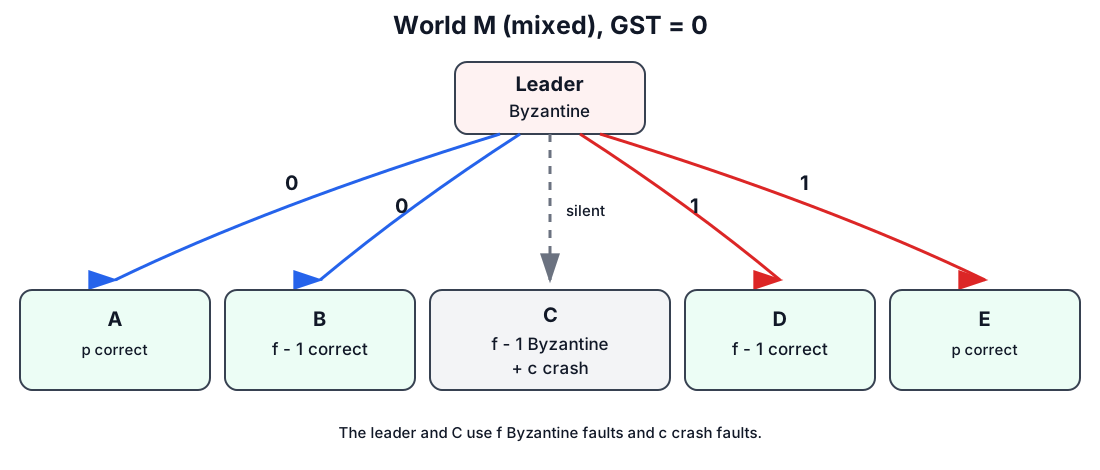
In the mixed world, the leader is Byzantine. Of the parties in $C$, $f-1$ are Byzantine and the remaining $c$ are crash faulty. Thus, all parties in $C$ are silent and the execution has exactly $f$ Byzantine faults and $c$ crash faults. Also, GST is $0$.
The leader sends $0$ to $A,B$ and $1$ to $D,E$. Since the protocol must eventually terminate even when the leader is Byzantine, all correct parties eventually decide the same value. Assume without loss of generality that they decide $1$. If they decide $0$ instead, swap $A$ with $E$, $B$ with $D$, and the roles of $0$ and $1$. We discuss randomized protocols below.
World $V$ (validity)
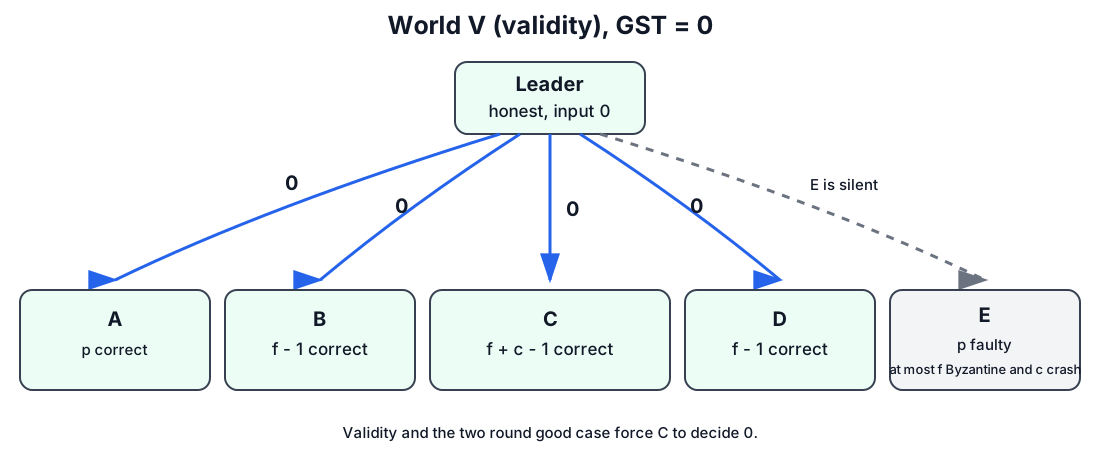
In the validity world, GST is $0$ and the leader is honest with input $0$. All parties in $E$ are faulty and remain silent. This is an allowed execution: $|E|=p\leq f+c$, so these faults can be divided into at most $f$ Byzantine faults and at most $c$ crash faults. It is also an execution to which the assumed two round good case applies because $|E|=p$.
The parties in $C$ hear the leader’s value $0$ and receive the same first-round voting messages for $0$ from $A,B,D$. Since the leader is honest, validity requires every correct party to decide $0$. The assumed good case latency requires the parties in $C$ to decide $0$ within two rounds.
World $\hat D$ (corrupt)
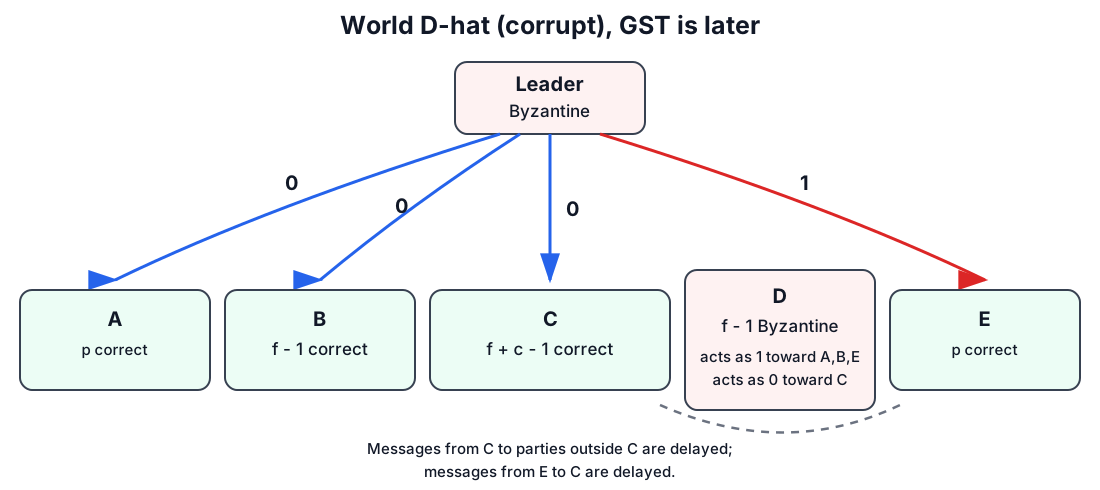
In this world, the leader and all parties in $D$ are Byzantine. Since $|D|=f-1$, there are exactly $f$ Byzantine parties. This execution does not need to use any of the allowed crash faults. Keep the network asynchronous until after the decisions described below, and then let GST occur.
The leader sends $0$ to $A,B,C$ and $1$ to $E$. The Byzantine parties in $D$ behave toward $A,B,E$ as if they had received $1$, exactly as the honest parties in $D$ do in world $M$. Toward $C$, they send the first-round voting messages they would have sent after receiving $0$, exactly as the honest parties in $D$ do in world $V$.
Before GST, delay every message sent by a party in $C$ to a party outside $C$, and delay every message from $E$ to $C$. Deliver all other messages so that:
- the parties in $B,E$ see the same messages as in world $M$ until they decide; and
- the parties in $C$ see the same messages as in world $V$ through their two round decision point.
The parties in $B,E$ cannot distinguish worlds $M$ and $\hat D$ through their decision points. Therefore, they decide $1$ in world $\hat D$. In particular, $E$ is nonempty because $p\geq1$, so at least one correct party decides $1$. The parties in $C$ cannot distinguish worlds $\hat D$ and $V$ through the good case decision point. Therefore, they decide $0$ in world $\hat D$.
The contradiction
World $\hat D$ has only $f$ Byzantine parties and no crash faults, yet correct parties decide different values. This violates agreement.
To group the indistinguishability claims: first, $B,E$ cannot distinguish worlds $M$ and $\hat D$, which moves the decision $1$ from $M$ to $\hat D$. Second, $C$ cannot distinguish worlds $\hat D$ and $V$ through its decision point, which moves the decision $0$ from $V$ to $\hat D$. The two links force conflicting decisions in the same execution.
This contradicts the assumption that the protocol has good case latency of two rounds.
Notes
-
For randomized protocols with always-correct agreement and validity and almost-sure termination, choose a value decided in $M$ with positive probability (at least one half for binary decisions). There is then a finite time $T$ by which that value is decided with positive probability. Couple the random choices in the indistinguishable views and set GST in the corrupt world later than both $T$ and $2\delta$. The same construction violates agreement with positive probability. This avoids choosing GST based on an unbounded wait for a randomized decision.
-
The parameter $p$ removes the even or odd case distinction that appears in the original proof of Hydrangea. The sets $A$ and $E$ both contain $p$ parties, while $C$ contains $f-1$ Byzantine parties and all $c$ crash faulty parties in the mixed world. The sets $B$ and $D$ stay at size $f-1$.
-
The proof requires a Byzantine leader, so the theorem assumes $f\geq1$. When $f=0$, no leader can equivocate and two round crash tolerant consensus is possible with $n=2c+1$. More generally, if there is a way to prevent even a Byzantine leader from equivocating, then a two round good case is possible already with $n=3f+2c-1$. Alpenglow obtains the closely related bound $n=3f+2c+1$ under its Assumption 3, which prevents the leader from equivocating. It tolerates $f$ Byzantine and $c$ additional crash faults under that assumption; its fast path requires $n-c$ matching votes, corresponding to $p=c$ in our notation. Taking $f=c$ gives $n=5f+1$, corresponding to their “20+20” configuration: roughly 20% Byzantine faults and an additional 20% crash faults. Thus, the Byzantine and crash only cases do not meet continuously at $f=0$ because the lower bound relies specifically on a Byzantine leader equivocating.
-
In their unpublished technical report Best-Case Complexity of Asynchronous Byzantine Consensus, Partha Dutta, Rachid Guerraoui, and Marko Vukolić give the bound $N_a>2Q+F+2M-2$ in Proposition L.4 (Section 4.2, page 19). In their notation, $N_a$ is the number of acceptors, $M$ bounds malicious acceptors, $F$ bounds total acceptor failures tolerated for liveness, and $Q$ bounds failures tolerated in the two round good case. Taking $M=f$, $F=f+c$, and $Q=p$ gives $n>3f+c+2p-2$. Their formulation distinguishes proposers, acceptors, and learners, with the privileged proposer also counted as an acceptor. Their proof uses a learner that decides and then crashes. Here, the parties in $C$ decide and remain correct in the corrupt world, while their outgoing messages are delayed. The report is EPFL I&C Technical Report 200499, revised February 2005.
-
Hydrozoan, by Qianyu Yu, Lefteris Kokoris-Kogias, and Alberto Sonnino, studies the same tradeoff in DAG-based consensus. Its basic construction uses $n=3f+c+2p+1$ validators and combines a two round fast path tolerating $p$ faults with a three round path under the full fault bounds. Section VI presents Optimal-Hydrozoan, a variant with $n\geq3f+c+2p-1$.
-
This post is part of our collection of lower bounds. See the Lower Bounds chapter for more results and proof techniques.
Your thoughts/comments on X.